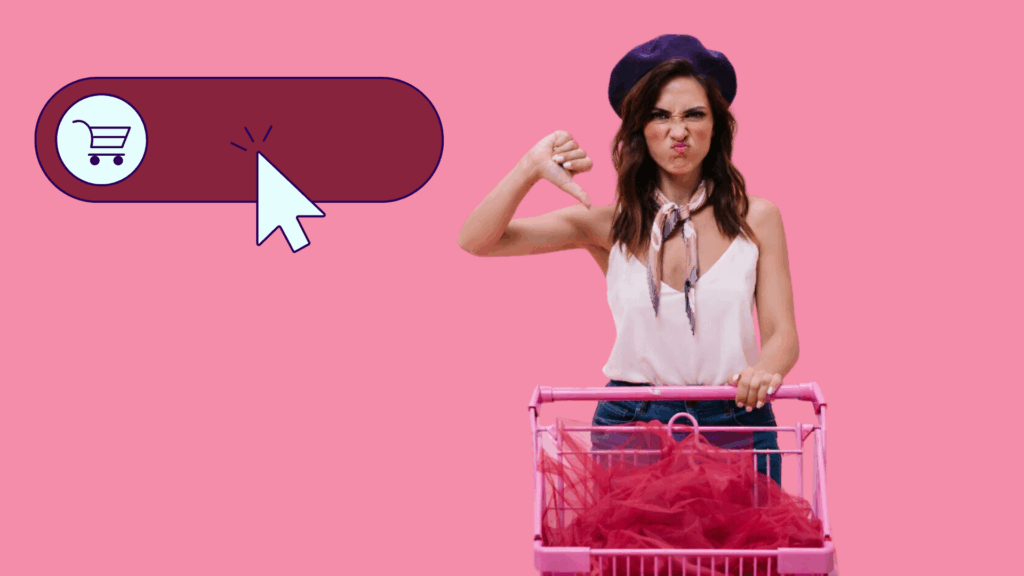
How can I reduce abandoned carts in my e-shop?

how-can-i-reduce-abandoned-carts-in-my-e-shop

10 + 1 ways to reduce abandoned carts and increase your e-shop sales

“How can I reduce abandoned carts in my e-shop?”

Abandoned carts are one of the most critical KPIs in ecommerce.

They don’t indicate user indifference — they indicate friction with the purchasing process and your e-shop in general. The user wanted to buy. But somewhere they:

  • got blocked
  • got confused
  • or lost trust

Beyond the above, there is also another reason visitors abandon their cart: high shipping costs.

In this article, I analyze 10 practical actions that substantially reduce abandoned carts and increase completed purchases while the customer is still inside your e-shop.

Actions you can take after the customer leaves the e-shop will be covered in the next article.

1. Show clear costs before checkout

One of the main reasons for abandonment, as mentioned above, is hidden or delayed costs.

In practice, many e-shops display shipping fees and extra charges only at the final step. This creates frustration.

What can you do about it?

Allow shipping cost calculation directly from the cart and include labels such as “Final amount.”

This is appreciated not only by visitors but also by AI SEO, which “reads” it as user-service intent.

2. Make guest checkout the default option

Mandatory account creation dramatically increases abandonment, especially on mobile.

  • Guest checkout must be simple
  • Account creation should be accompanied by specific benefits and repeated as a prompt even after purchase

Think of registration as an additional marketing asset — not a prerequisite for a sale.

3. Ask only for essential information

Every form field is a point of micro-friction and frustration. Review what information you request:

  • Are you asking for data you don’t immediately need?
  • Are there duplicate fields (e.g., billing/shipping address)?
  • Does your e-shop support mobile autofill?

4. Do you have a mobile-first checkout?

As expected, the majority of abandonments happen on mobile. Your goal should be a checkout designed first for mobile and then for desktop.

Check whether:

  • buttons are too small
  • dropdowns are difficult to use
  • the keyboard covers important fields

5. Check loading speed, especially at checkout

Even one extra second during checkout increases abandonment.

Check:

  • third-party scripts (tracking, chat, pixels)
  • heavy payment plugins
  • server response time

6. Provide clear security & trust signals

Transaction security is the number-one reason a user ultimately decides to purchase from YOUR e-shop.

A first-time customer thinks: “Should I enter my card details here?”

Make them feel safe by showing:

  • SSL & security badges
  • payment logos
  • a clear return policy

7. More payment methods = fewer abandoned carts

Every visitor has payment preferences. When they don’t find them, they don’t complain — they simply leave.

Provide options such as:

  • Cards
  • Wallets
  • Cash on delivery
  • Alternative payment methods

Bank transfers can be tedious to verify, and cash on delivery can sometimes cause issues when orders are refused. Keep them as options and measure how often they cause problems.

You can also remove them temporarily and evaluate lost sales and changes in abandonment rates before deciding whether to keep them.

8. Clear information about shipping & returns

Uncertainty is the enemy of conversion. The user needs to know:

  • when the order will arrive
  • who delivers it
  • what happens if they change their mind

These details increase comfort, especially for lesser-known e-shops or for products widely available elsewhere.

9. Use psychological triggers in the right places

Small messages placed strategically can significantly reduce abandonment. For example:

  • “Free returns”
  • “Limited stock available”
  • “Purchased recently”
  • “X customers are viewing this product right now”
  • “Your cart will remain active for 15 minutes”
  • “Our special discounts last for 30 minutes”

10. Behavior analysis and continuous optimization

There is no “perfect checkout,” only an optimized one.

To optimize, measure:

  • where users abandon
  • on which device
  • with which payment method
  • for which products

Every data point can help improve checkout performance.

When an abandoned cart cannot be avoided

No matter how optimized a checkout is, some abandonments are not caused by e-shop mistakes.

Instead, they result from consumer psychology, comparison behavior, or strategy.

Understanding these cases is critical because it:

  • prevents incorrect conclusions,
  • helps interpret data properly,
  • improves remarketing strategy.

Let’s look at situations where the e-shop functions perfectly, yet the consumer still abandons the cart.

1. The cart as a “wishlist”

Many users do not intend to buy immediately. They use the cart to:

  • see the final cost,
  • compare products,
  • save items for later purchase.

2. Price comparison with competitors

Users may reach checkout just to perform a price check. If they find a lower price or better shipping terms elsewhere, they will leave — even if your checkout is flawless.

3. Psychological “cool-off” before purchase

For expensive products, the brain activates a delay mechanism. The user thinks: “Should I buy this now or think about it?”

Here, abandonment is self-protection, not rejection.

4. No immediate need

The user wants the product but doesn’t need it right now. This is common in fashion, home decor, and lifestyle categories.

The issue is timing — not your e-shop.

5. Waiting for a deal or discount

Some users intentionally abandon carts while waiting for a coupon, free shipping, or seasonal sale.

If you always offer discounts afterward, you train the wrong behavior.

6. Temporary financial constraint

The user may lack available budget at that moment, be waiting for their salary, or have other priorities. Interest exists — purchasing power does not.

7. Simple change of mind

Yes, it happens. Not because something went wrong, but because the user got bored, changed mood, or found something else. This cannot be fixed technically.

8. Abandoned cart as a remarketing trigger

This was common in the U.S., where visitors discovered that abandoning a cart often triggered an email with a discount on the product.

In such cases, recovery strategy should not rely solely on discounts.

Abandoned carts are not just about usability or structure. They are an economic indicator that directly affects:

  • Advertising costs
  • ROAS
  • The e-shop’s ability to scale sales

Reducing abandoned carts requires a strategy combining user experience, technical clarity, and trust.

E-shops that systematically work on these areas:

  • increase sales
  • reduce advertising costs
  • improve overall brand perception

When approached correctly, abandoned carts stop being a problem and become a profitability optimization tool.

In my next article, we will examine the metrics you should track for cart abandonment and the strategies to bring back customers who left products in their cart after exiting the e-shop.

If you would like help from our team with all of the above, contact us

If you would like to get to know us, you can book a free one-hour meeting so we can strategically guide you regarding your digital activities


The Anatomy of a Brand

what is branding and its building blocks

What is branding and its building blocks?

The word brand is used almost everywhere today. We encounter it in discussions about businesses, marketing, social media, and even in people’s personal image.

Nevertheless, few can clearly explain what a brand truly is, what it consists of, and why two companies selling similar products can have completely different power in the market and in people’s minds.

The anatomy of a brand is not only about the logo, the colors, or the slogan. These are external characteristics.

The essence lies deeper, in the way a brand thinks, speaks, behaves, and emotionally connects with its audience.

Brand is perception 

To understand what a brand is, we must separate key concepts that are often confused: brand, branding, brand values, brand positioning, brand narrative, brand voice, and brand tone.

It is what exists in a person’s mind and emotions when they hear a name. And ATTENTION: It is not what you say about yourself, but what others believe about you.

A brand is reputation, expectation, experience, and emotion—all at once.

Branding is the process

 It includes all the conscious choices you make to influence that perception. From how you speak, how you design the experience, how you respond to a complaint, to what you publicly support and what you do not. Branding is not a campaign, it is continuous action.

Brand values are principles

Brand values are the principles that guide a brand’s decisions.
They are not words on a slide deck. They are the filter through which every choice passes. When a brand has clear values, it knows what to do—and, more importantly, what not to do.

Brand positioning

Brand positioning is the place a brand occupies in the audience’s mind in relation to competitors.
It’s not just about the target group; it’s about the unique promise. It answers one key question: why should I choose you over someone else?

Brand narrative is the story

Brand narrative is how a brand explains who it is, where it comes from, and why it exists.
People don’t connect with product features—they connect with stories. A strong narrative gives meaning to a brand’s existence.

Brand voice is personality

Brand voice is how a brand speaks over time. Is it friendly, serious, rebellious, poetic, strict? Brand voice doesn’t change from day to day. It remains consistent.

Brand tone is adaptation

Brand tone is how that voice adapts to different situations.
The same brand can speak differently in an inspirational campaign and during a crisis announcement—without losing its identity.

Examples

To make clear what is branding and its building blocks, let’s look at international examples where brands in the same industry follow completely different brand anatomies.

Fashion example: Urban Outfitters and Zara

Urban Outfitters is not just a clothing company. Its brand is tied to a specific lifestyle.
Its positioning is built around youth culture, alternative aesthetics, a sense of underground creativity, and expressive individuality.

It doesn’t speak to everyone—it speaks to people who want to feel outside the mainstream of fashion.

Urban Outfitters’ brand values revolve around self-expression, individuality, creativity, and a subtle resistance to the mainstream. This is reflected not only in the clothes, but also in store design, music selection, product curation, and content creation.

Its brand narrative doesn’t say “we sell clothes.”It says “we give you a way to express who you are.”

The story it tells is one of youth culture, college towns, artists, and people who don’t want to look like everyone else.

Its brand voice is effortless, youthful, slightly ironic, and authentic. It doesn’t aim for perfection—it aims for character.
The tone may be more playful on social media or more neutral in commercial communication, but the voice remains unmistakable.

Zara, on the other hand, has a completely different brand anatomy.

Its positioning is not about self-expression, but about access to fashion. The promise is simple and clear: current trends, fast, at an affordable price.

Zara doesn’t sell identity as a lifestyle—it sells fashion as a service.

Its brand values focus on speed, efficiency, and availability. Its narrative is not personal; it’s functional:
“What you see on the runways, you can find here—now.”

Zara’s brand voice is neutral, clean, almost invisible. It doesn’t want to draw attention to itself—it wants the product to speak. The tone adapts to each collection, always within a framework of discreet elegance.

Both companies sell clothes. But Urban Outfitters sells identity, while Zara sells fashion as a solution.
This is branding in action.

Sportswear example: Nike and Adidas

In the sportswear sector, Nike and Adidas are a classic example of different brand anatomies.

Nike has built its brand around the concept of transcendence. Its brand positioning is not “sportswear,” but “personal victory.” The famous Just Do It is not a slogan; it is a life philosophy.

Nike’s brand values relate to determination, self-improvement, belief in oneself, and progress. Its brand narrative is filled with stories of people overcoming obstacles, not necessarily professional athletes, but everyday individuals.

Nike’s brand voice is dynamic, inspirational, often emotionally charged. The tone can become aggressive, moving, or empowering, but it always serves the same idea: you can make it.

Adidas, on the other hand, positions its brand more around the connection between sport and culture. Its brand positioning is based on authenticity, heritage, and its connection with street culture and music.

Adidas’ brand values include authenticity, collaboration, and respect for history. Its brand narrative does not speak only about performance, but about how sport influences culture and style.

Adidas’ brand voice is calmer, more cultural, less aggressive than Nike’s. The tone adapts according to each collaboration, whether with athletes or artists, but maintains a sense of cool confidence.

Here too, the products may look similar. But the brands speak to different emotions.

So we have seen that the anatomy of a brand is a system. You cannot choose only one element and ignore the rest.

A brand without values is empty. Branding without consistency is noise

Positioning without narrative is weak. Voice without strategy is merely style.

Strong brands do not try to please everyone.

Strong brands do not try to please everyone. They try to be clear. And that clarity is what ultimately makes them unforgettable.

Now that you know what is branding and its building blocks, would you like us to help you build your brand or rebrand?

If you would like help from our team with all of the above, contact us

If you would like to get to know us, you can book a free one-hour meeting so we can strategically guide you regarding your digital activities
Arsenis Paschopoulos on the Board of Directors of SEDE

o-arsenis-paschopoulos-sto-dioikitiko-symvoulio-tou-sede

With great honor, we announce the election of Arsenis Paschopoulos, founder of Just Online, to the Board of Directors of SEDE, with responsibility for the Education sector.

SEDE is the institutional body representing businesses of the digital ecosystem in Greece, and its mission is “to support its members in improving the provided online services, through targeted institutional interventions, education, research, and innovation.” Within this framework, the role of education is decisive—not only for skills upgrading, but also for the overall maturation of the market.

Arsenis Paschopoulos has been active in the field of digital marketing since 1996, having experienced firsthand the transition from the early web to today’s modern, data-driven and AI-assisted digital environment. Over more than 30 years of his professional career, he has collaborated with hundreds of businesses, designed and implemented growth strategies in Greece and abroad, and has actively contributed to the dissemination of practical, business-oriented knowledge around digital, with thousands of “students” to his credit.

His participation on the Board of Directors of SEDE, responsible for training and education, aims at the creation of programs and initiatives that:

  • bridge theory with the real market
  • respond to the contemporary needs of businesses and professionals
  • enhance the quality and reliability of the digital ecosystem in Greece

For Just Online, this is a natural continuation of its philosophy: active participation in the industry, knowledge transfer, and a long-term perspective. At the same time, the collaboration with SEDE further strengthens the company’s momentum, connecting it even more meaningfully with the developments, the people, and the decisions that shape the future of digital in Greece.

Valentine’s Day: how to make customers fall in love with your brand

In about 2 weeks we celebrate one of the most controversial and commercialized holidays: Valentine’s Day.

That’s why we have prepared a list of 20 actions that you must take in order to bring customers into the arms of your … e-shop and make them fall in love with your brand

Eshop

Homepage: change your main banner with one or more themed banners or make a special visual high on your homepage for Valentine’s Day. Describe the actions you are taking for this day (discounts, special gifts, contests)

Special landing page: create a special page where all your Valentine’s Day social media posts and ads will end up.

This page can include the categories of products you recommend for the day, gift ideas based on the gender, age and money available, a contest and product delivery information.

Logo: make a Valentine-themed variation of your logo

Trade policy: limited number of pieces, discounts, 2+1 gifts and (of course) free shipping are some of the trade policies you can use to make your visitors buy from you without looking for alternatives in other eshops

Contest: create a popup (or special banner) that will lead to a Valentine contest (more about contests at the end of the article).

Product delivery: make clear (with a banner or even a countdown mechanism) the last day and time you need to receive the order in order to deliver it on time.

Even better, make a special deal with the courier company you work with for extra fast orders and inform your eshop visitors about fee gradations.

Email & Viber

If you’ve run Valentine’s Day contests in the past, the list you’ve created is the hottest to use again to bring back Valentine’s Day attendees to your eshop in previous years.

To get even more information from your already registered users, ask them if they are looking for a gift, how much money they want to allocate and for which gender so that you can send them corresponding ready-made proposals or direct them to a specific section (for example gifts for her) of your eshop.

If not, it’s an opportunity to enrich your list with one of the contests I’ll suggest below.

Through email & Viber you can of course also express your appreciation to your customers by giving them a gift such as extra points (without making purchases) in the loyalty system or encouraging them to make purchases to enter this system, by earning more than the usual points.

And of course don’t forget to make clear through these two communication channels the day the order should be placed so that it is delivered on time.

With contests

Contests as a tool can be useful to you in many ways.

Contests that will generate UGC

These contests will be held for you so that the followers will create content (user generated content) for you.

  • Show us your Valentine: Ask your followers to take a photo or a video with their love.
  • Show us your love: Ask your followers to take a photo with one of your products or share why they love your brand.

Contests to get information about your followers

  • If you’re a travel agency: “Send us your dream vacation on Valentine’s Day”
  • If you sell gadgets: “Tell us what gadget will make your day on Valentine’s Day.”
  • If you have a hair salon: “Send us the hairstyle you like and win it”
  • If you have a super market: “Tell us what you want to cook on Valentine’s Day and win the ingredients”

Contests to increase interaction

In this case the most common method is to complete a sentence in the comments.

For example, if you sell cosmetics: “Even more beautiful for Valentine’s Day. I would like a ________ cream” (ask them to tell you).

Or ask them to tag the person they will be spending Valentine’s Day with.

Don’t forget advertisment

None of the above will be successful if you don’t advertise it.

The HOT audiences you will target are:

  • The visitors of your eshop who have bought in the past
  • All other visitors who have not made purchases
  • Those who have interacted with your social media presences
  • Those who state that are “in a relationship” or “it’s complicated”
  • Those looking for “gifts”, “Valentine”, …

If stocks allow, do not stop advertising until the courier company you work with tells you that they are unable to deliver.

But even in this case you can give the opportunity to those who are in love to order with an extra discount something from your eshop and receive it the next day or some other day.

What if you don’t sell gifts suitable for Valentine’s Day?

In this case turn to the “singles” and urge them to give themselves a gift “because they deserve it”.

Where will you find them? But with the Facebook & Instagram ad filter that lets you find singles and divorced.

You can also target with Google ads keywords and content like “anti-Valentine” “alone at Valentine’s day” etc.

You can also run a contest for singles or give away a really big discount or giveaway, ONLY for Valentine’s Day (so you can “pull” the extra disposable income of that day)

Good luck and … don’t forget to fall in love!

If you need help with the above actions, please contact us

To Skroutz or not to Skroutz?

Skroutz, e-food, booking, …: is there “life” for your brand without them?

You’ll notice that I put the word “brand” and not the word “business” in the title. Because it is completely different to talk about the life of a brand than the life of a business.

What is a business? An organization that markets products/services, has a specific target audience and aims to make a profit.

What is a brand?

Since I’ve already written about branding, I’ll go straight to the “grit”: it’s the “mark” you leave on the consumer’s mind and manage to make him think of your brand name when he has the need or desire to buy a product or a service

Batteries; C_____

Books; P____

Computers? PI____

What gives life to a brand? Apart from the classic 7Ps of marketing (product, price, place, promotion, people, physical evidence, processes) which build the brand, the most important thing is the “promise”, personality and values, which make it STAND OUT in the mind of the consumer.

What kills a brand?

Since what makes a brand special gives it life, what kills a brand is its “bashing” with many other brands where the main selection criterion is price.

This is exactly what happens when your brand enters price comparison platforms (Skroutz, Bestprice, …) and/or aggregating sites (e-food, booking, …)

“But from the moment I came in, sales went up”

Sales yes, but not your brand awareness.

What have these platforms accomplished? From “ordering pizza” to “enter e-food, wolt,…” and from searching for “men’s clothing XXX” to entering Skroutz and Bestprice and doing a search that will give us specific results.

“But is this bad? Doesn’t it give the consumer choices?”

Yes, but it takes him away from your brand. The consumer knows, thinks and remembers Skroutz, e-food, Wolt, Booking and not your name.

“But is it bad if sales go up?”

In the long run yes. Because whoever “keeps” the consumer also gains power: power to increase the commission you will give him, power to keep the consumer on his own platform and his own basket, power to make the delivery of the product so that HIS OWN impression is made brand even more strongly in the mind of YOUR customer. In other words, power to promote his own brand and overshadow yours.

And so you become a mere supplier of the platform and – to be able to increase your sales – you end up reducing your price and margins even more. And when you get to the point where you can’t bear to stay in the market, you may have to become an employee of the platform in some kind of pizza production “farm”, or the platform will make its own imports and throw you out of the market.

“But since everyone (everyone???) gets in there, what should I do?”

Do judo marketing.

What do you do with judo? You use your opponent’s strength to your advantage. So you too will use the power of these channels to make your brand known and win customers.

How?

Branding by “arriving” in the hands of the customer

If you sell a product, you have the advantage of packaging to impress your brand on the mind of the consumer. During the days when I was confined to my house for 14 days after a 10-day Covid-19 hospitalization, I did an experiment: I ordered food from five different restaurants through one of the food ordering platforms.

Only ONE of them sent the food in its own packaging, neat, with the restaurant’s logo visible. All the rest had the undifferentiated black plastic with the clear lid and the clear bag, or rather a paper bag with no logo.

“Steal” the consumer from the platform

Apart from the packaging that will attract your customer’s attention, you could take it a step or two further: have a fridge magnet and a leaflet with recipes / recommendations of the month.

The form could have a QR code (you know, the one that looks like a checkerboard and you scan it with your mobile phone) to link to your restaurant site or your mobile app where you will enable direct purchases but (to incentivize repeat visits) and recipes / tips / suggestions for nutrition and exercise.

I’m not telling you to work with a nutritionist and personal trainer so you don’t lose a lot, but it would really make a difference and cost you little (or nothing).

You could also have a unique code in the form or on the site or in the application that will link to a contest EVERY MONTH, with participants able to take part every time they order food from the restaurant.

Finally, you should have an evaluation form for the customer to fill out, either online or in physical form (and send it by simply photographing it) by entering a draw again or having a discount or winning a soft drink on the next order.

When you succeed and bring him to your eshop, you will have the opportunity to use remarketing ads as well as email or sms marketing to remind him of what he saw and what benefit he has to come back and keep buying from you.

These are the easy ones.

The difficult thing is to become different and the REFERENCE POINT in the mind of the consumer when he thinks, for example, “Glyfada Skewers”.

And that’s what BRANDING does. And if the recipe succeeds, your brand becomes irresistible and “enter e-food / Skroutz / Booking becomes…

Batteries; C_____

Books; P____

Computers? PI____

Skewers? Hotel; Electronics; Clothes; Your brand

Will you dare?

Listen to the related podcast here:

image source= https://www.wallpaperflare.com/

Justonline Agency
Privacy Overview

This website uses cookies so that we can provide you with the best user experience possible. Cookie information is stored in your browser and performs functions such as recognising you when you return to our website and helping our team to understand which sections of the website you find most interesting and useful.